
“There’s gonna be a revolution. It’s totally going to happen. I ain’t got a flicker of doubt that this is the end. This is time to wake up.” Russell Brand
So, Russell, I’m awake. My eyes are open and have been open for some time, but I wonder what part I am to play in this revolution and I fear that destroying and rebuilding our political landscape in such dramatic a fashion may obliterate much of the foundation on which a new political paradigm must establish itself. Such uncertainty mixed with justifiable animosity toward the political elites has left many of us in a state of furious inertia. I have many fears: my fear is of what could happen if we make a serious challenge to Western ‘democracy’; what will happen to those who are vulnerable and in need of stability and certainty to anchor them, because living with a mental illness in a time of uncertainty is too dangerous a thing to dismiss. It isn’t enough to buy into some vague notion of revolution. We need change, that is self evident, but the change the vulnerable in society deserves is one that speculates and does not shatter the glass houses of the elites in the hope that something wondrous will emerge in its place. When you speak of an end, Russell, you pierce my heart with a poisonous dart, for I ask for consistency and support; I haven’t got the mental reserves to await this change for the better to come out of the ashes of the now. Perhaps it is true that what we are doing is “not dramatic enough, not radical enough”, but my revolution is a fight against stigma; my fight is against social isolation and marginalisation; my fight is with myself. My revolution is to wake up in the morning and know that I am safe.
Can this revolution speak for us?
In his seminal work Madness and Civilisation, Michel Foucault states that, in the modern world, madness is not just internal or pathological as it was once perceived: an important component of ‘madness’ is the impact that social pressures have on the mind. These pressures operate on the internal family dynamic which dictates how they treat the designated ‘mad’ members. This is a result of a trickle down effect: social pressures placed upon society and the family lead to pressures being exerted on the vulnerable in order to contain or detain individuals. An underclass emerges that, whilst being treated for being ill, their rights and position are reconstructed. For Foucault, society should be accountable to the mentally ill, not the other way around: the tongue of the mad (in his case, he cites Nietzsche and Goya) speaks out against the restrictions that seek to bind it. This is as true now if not more so than it was for Foucault in 1961.
I wonder whether this ‘tongue of the mad’ will have the space to assert itself within the landscape of an emergent new paradigm.
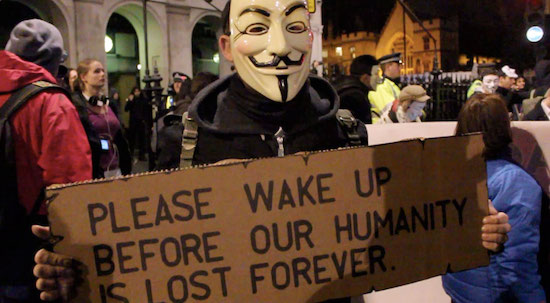
But isn’t revolution oh-so-exciting for those who seek chaos out of suppression? We look to an idol to show us the way. The idea of revolution now has a recognisable face: the now ubiquitous V for Vendetta mask. I understand the need to hide. I understand the urge to operate under the cover of another’s voice. But for me a mask is real, because living with a mental illness and exercising my political will exist on two separate plains. I want change. I don’t want to have to worry about whether the NHS can absorb increasing numbers of patients suffering mental distress. The recession itself has had a deleterious impact on resources through cuts in local authority social care and restrictions on NHS funding. It is a continual march toward tragedy. And I am furious and terrified. I demand that this be addressed and that service users be the primary voice that drives change and improvement. We won’t stand for this ‘give with one hand, take with another’ approach anymore to appeasing people in the public sector. And I resent the fact that I cannot exist in the system because the funding simply does to exist to acknowledge the long-term impact that having bipolar disorder has on my life. While the term ‘remission’ gives the illusion of well-being, for some this is incredibly frightening because they can disappear from the system completely. ‘Remission’ is a convenient term for those who wish to claim that the system works “look at all this cured people!” The certainty of a caring society is now in doubt because each person is an increment of social capital, not an individual with needs. Will this imminent revolution address this problem head-on? No. There is no egalitarian system that can sweep this aside; no system to pick up those who have vanished and slipped through the cracks.
The psychological impact of uncertainty
I am isolated. The impact that my illness has had on my life has at times been profound. Do I wish for my voice to be heard? Damn right! Do I think I am being heard? I do not. There is not only a disparity of wealth in our current political environment, but there is a disparity of esteem also. I am not, and never claim to be, wholly disadvantaged. I am not completely disenfranchised. I have benefited from an outstanding education and have reaped the rewards of hard work. But when I chose to walk away from my career because I no longer felt I could sustain my sanity is a sector that, perhaps rightfully, did not have the resources to absorb someone with a precarious mental illness. Living with backhanded support for fear of stepping over an ambiguous red line was living with covert discrimination and this is worse than overt stigma. I felt uncertain about every action I took, every conversation had in my absence. I was destroying myself. I was destroyed. So I elected to resign amidst the damage done.
I entered a world of monstrous ambiguity and challenges that I had not envisaged. This is what millions of people experienced every day and now I had joined the ranks of the voiceless and, yes, I too found myself disengaging from politics because I recognised the impact Whitehall’s impotence and apathy had on the greater society. I went from naiveté to cynicism. From supercilious prognosticating to silent rage. And I worried more than ever that stigma would cause more problems. When you drop out of system, it is often impossible to get back in. And so I slipped inexorably into crisis and within three months of my resignation I entered a dark and dangerous period when I seriously feared for my life. Had I disenfranchised myself? Was I now just an inconvenient statistic? Will society ever truly trust and integrate those with a mental illness into a system with so many systemic problems? A system that will need repairing brick by brick in the wake of this new revolution.
So, Russell, this revolution promises so much. Will the marginalised find their voice? Is there such a thing as egalitarianism? No one can answer those questions because jumping each hurdle reveals a new problem. Do I fear for the security for my community? Absolutely. But I want guarantees that a revolution cannot give me. Our revolution is our emancipation. The ‘tongue of the mad’ must be heard.


 Gulliver Unravelled