
Disparate Threads: ‘Arrange whatever pieces come your way.’ [1]

I aimed to write this post some months ago, after an experience in one of the more unlikely of places gave me something unexpectedly positive to hold on to. I believed this to be the piece that had been missing; this would be the critical thread that could help knit me back together.

It was whilst I was undergoing a surprisingly thorough health M.O.T. at my gym that I, for the first time, calmly confronted my diagnosis and engaged in a conversation that left me feeling liberated. It lifted the crushing sense of shame that had been pressing down on me more and more each day. Every molecule of time had felt contaminated and I began to fear I was contaminating everything and everyone around me too.

Sitting in a chair, recovering from a number of fitness tests (which left me convinced I had turned into a blimp), the woman asked if I took any medication. I took a sharp intake of breath. But I couldn’t avoid this as many medications place restrictions on exercise. So, I began listing them: salbutamol [pause] [another intake of breath], Lithium, Quetiapine – wait, the woman was drawing little circles with the computer mouse. We were entering a spelling vortex. I began to spell out the words for her, but it was clear that she was struggling. I offered to type the words in myself. Eventually, when I had finished, I had typed in four psychiatric medications, a medication, diazepam, taken PRN (Pro re nata – as needed) and an asthma inhaler.

She woman squinted at the screen: “That’s a lot of medication…” I laughed out loud and nodded. She laughed too, somewhat baffled. “Erm, ah, would you mind… can I ask what they’re for? It’s just that we kind of need to know what illness, ah, thing, they’re for… And could you maybe pop down too the dosages? I’m really sorry. I hope I’m not being rude?”

Was she being rude? Should I feel affronted by her inquisitiveness? The familiar wave of shame began to wash over me. But then, suddenly, the wave washed out to sea and I felt strangely calm. She wasn’t asking me these questions because she was unnerved by the sheer volume of medications, she was genuinely, and innocently curious, and I realized that I shouldn’t be ashamed at all. I remembered my friends, and do think of them as very good friends now, on Twitter who are in no way ashamed of having a psychiatric diagnosis. In fact, they are confidently upfront about their illness. And I have never been confidently upfront about any aspect of my illness. I had hidden it from my employers and this made my episode in 2010-11 all the more horrifying because I felt that I had been there on borrowed time, on false pretenses. Even though I had been well for three and a half years. Although it was my decision, the effects and aftereffects of that episode caused me to resign from my job in 2012. After only three years in post. However…

“I’m bipolar” There. I said it. I said it back to myself, almost inaudibly, just to check I’d actually said it.

“Oh. Goodness. That’s a bit like manic depression, right? I don’t know anything about that sort of thing. I mean, my mum suffers from bouts of depression, but that’s not the same. Can I ask you what it’s like?”

And I answered her, as full and frank as I thought was appropriate, given I was sitting in an office in a gym!

A weight was lifted. Yes, I am bipolar. Yes, it is often terribly debilitating. Yes, it is sometimes fantastic. No. I am not ashamed of who and what I am. I could finally bring the disparate threads and cumbersome pieces of my past and present together.

***

That was March this year.

It is now September. And I no longer feel liberated. Again I feel the cloak of shame wrapping itself around me.

I am ashamed of the behaviour I exhibited whilst in crisis. I am reticent to socialize with people because I am terrified that I have BIPOLAR tattooed on my forehead, clearly, for everyone to see. I am fearful of the whole world because I don’t believe it has space for me and my particular brand of crazy. Or at least people don’t have space for the brand of crazy I have exhibited in the past.

I take my medication: Lithium, Quetiapine, Aripriprazole, Lamotrigine (and diazepam and zopiclone – PRN). Nothing changes. Nothing stays the same. I’m all at sea. When I said I was comfortable with all of this, I was kidding myself. I do recognise that I have a disability, but I would hide it again.

Perhaps I’m writing this so it will be the confession I cannot do in person. I will tell people I blog so that they can listen to my digital voice and not my stilted and stuttering other self. A self that is galaxies away from the best me, the me that had it all and blew it completely out of the water. The me that won’t talk to you if you ask and won’t tell you if there is a problem because she simply cannot explain it. She doesn’t have the vocabulary anymore.

I’m bipolar, but I’m not. I can’t handle the pieces that come my way.

[1] Transcriptions – To The Lighthouse – Diaries – Diary Of Virginia Woolf
Posted in Mental Health | Leave a comment

What about our revolution? Mental illness in a new political paradigm.

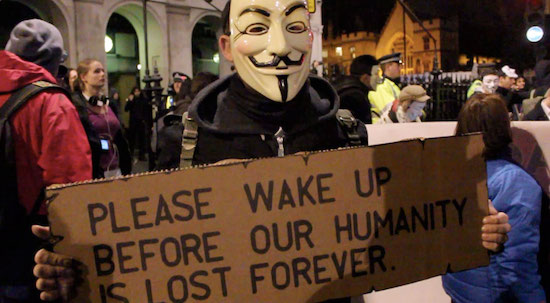
“There’s gonna be a revolution. It’s totally going to happen. I ain’t got a flicker of doubt that this is the end. This is time to wake up.” Russell Brand

So, Russell, I’m awake. My eyes are open and have been open for some time, but I wonder what part I am to play in this revolution and I fear that destroying and rebuilding our political landscape in such dramatic a fashion may obliterate much of the foundation on which a new political paradigm must establish itself. Such uncertainty mixed with justifiable animosity toward the political elites has left many of us in a state of furious inertia. I have many fears: my fear is of what could happen if we make a serious challenge to Western ‘democracy’; what will happen to those who are vulnerable and in need of stability and certainty to anchor them, because living with a mental illness in a time of uncertainty is too dangerous a thing to dismiss. It isn’t enough to buy into some vague notion of revolution. We need change, that is self evident, but the change the vulnerable in society deserves is one that speculates and does not shatter the glass houses of the elites in the hope that something wondrous will emerge in its place. When you speak of an end, Russell, you pierce my heart with a poisonous dart, for I ask for consistency and support; I haven’t got the mental reserves to await this change for the better to come out of the ashes of the now. Perhaps it is true that what we are doing is “not dramatic enough, not radical enough”, but my revolution is a fight against stigma; my fight is against social isolation and marginalisation; my fight is with myself. My revolution is to wake up in the morning and know that I am safe.

Can this revolution speak for us?

In his seminal work Madness and Civilisation, Michel Foucault states that, in the modern world, madness is not just internal or pathological as it was once perceived: an important component of ‘madness’ is the impact that social pressures have on the mind. These pressures operate on the internal family dynamic which dictates how they treat the designated ‘mad’ members. This is a result of a trickle down effect: social pressures placed upon society and the family lead to pressures being exerted on the vulnerable in order to contain or detain individuals. An underclass emerges that, whilst being treated for being ill, their rights and position are reconstructed. For Foucault, society should be accountable to the mentally ill, not the other way around: the tongue of the mad (in his case, he cites Nietzsche and Goya) speaks out against the restrictions that seek to bind it. This is as true now if not more so than it was for Foucault in 1961.

I wonder whether this ‘tongue of the mad’ will have the space to assert itself within the landscape of an emergent new paradigm.

 But isn’t revolution oh-so-exciting for those who seek chaos out of suppression? We look to an idol to show us the way. The idea of revolution now has a recognisable face: the now ubiquitous V for Vendetta mask. I understand the need to hide. I understand the urge to operate under the cover of another’s voice. But for me a mask is real, because living with a mental illness and exercising my political will exist on two separate plains. I want change. I don’t want to have to worry about whether the NHS can absorb increasing numbers of patients suffering mental distress. The recession itself has had a deleterious impact on resources through cuts in local authority social care and restrictions on NHS funding. It is a continual march toward tragedy. And I am furious and terrified. I demand that this be addressed and that service users be the primary voice that drives change and improvement. We won’t stand for this ‘give with one hand, take with another’ approach anymore to appeasing people in the public sector. And I resent the fact that I cannot exist in the system because the funding simply does to exist to acknowledge the long-term impact that having bipolar disorder has on my life. While the term ‘remission’ gives the illusion of well-being, for some this is incredibly frightening because they can disappear from the system completely. ‘Remission’ is a convenient term for those who wish to claim that the system works “look at all this cured people!” The certainty of a caring society is now in doubt because each person is an increment of social capital, not an individual with needs. Will this imminent revolution address this problem head-on? No. There is no egalitarian system that can sweep this aside; no system to pick up those who have vanished and slipped through the cracks.

The psychological impact of uncertainty

I am isolated. The impact that my illness has had on my life has at times been profound. Do I wish for my voice to be heard? Damn right! Do I think I am being heard? I do not. There is not only a disparity of wealth in our current political environment, but there is a disparity of esteem also. I am not, and never claim to be, wholly disadvantaged. I am not completely disenfranchised. I have benefited from an outstanding education and have reaped the rewards of hard work. But when I chose to walk away from my career because I no longer felt I could sustain my sanity is a sector that, perhaps rightfully, did not have the resources to absorb someone with a precarious mental illness. Living with backhanded support for fear of stepping over an ambiguous red line was living with covert discrimination and this is worse than overt stigma. I felt uncertain about every action I took, every conversation had in my absence. I was destroying myself. I was destroyed. So I elected to resign amidst the damage done.

I entered a world of monstrous ambiguity and challenges that I had not envisaged. This is what millions of people experienced every day and now I had joined the ranks of the voiceless and, yes, I too found myself disengaging from politics because I recognised the impact Whitehall’s impotence and apathy had on the greater society. I went from naiveté to cynicism. From supercilious prognosticating to silent rage. And I worried more than ever that stigma would cause more problems. When you drop out of system, it is often impossible to get back in. And so I slipped inexorably into crisis and within three months of my resignation I entered a dark and dangerous period when I seriously feared for my life. Had I disenfranchised myself? Was I now just an inconvenient statistic? Will society ever truly trust and integrate those with a mental illness into a system with so many systemic problems? A system that will need repairing brick by brick in the wake of this new revolution.

So, Russell, this revolution promises so much. Will the marginalised find their voice? Is there such a thing as egalitarianism? No one can answer those questions because jumping each hurdle reveals a new problem. Do I fear for the security for my community? Absolutely. But I want guarantees that a revolution cannot give me. Our revolution is our emancipationThe ‘tongue of the mad’ must be heard.


Image

Posted in Mental Health, Society, Culture, Politics, Economics | Leave a comment

The Great Emoti-Con: well-being and emotional intelligence

It occurred to me this past weekend that I have lost traction on my emotions. I went to see Captain Phillips. It was a packed cinema and you could sense the tension and anxiety in the audience: I could sense it, but I couldn’t experience it myself. It wasn’t a flattening exactly, more a lack of understanding about how emotions position me within my environment. I have a clear memory of how I have reacted to things in the past, but I can’t seem to apply this memory to equivalent events and moments in the present. Throughout the years, I have had to struggle and battle against an abundance of emotion that often spills out, disproportionately and dangerously, into my life. Somewhere over the past three years (a time punctuated by severe mental health crises) my emotional roadmap for applying appropriate emotions has been lost. Perhaps I need to start from scratch and reconnect with emotion. The trouble is I don’t really know how or whether this is too simple a solution. Bipolar disorder is the consummate conman: it tells you that your feelings are right and wrong, or broken or insufficient, and it leaves no room to put the brakes on or to rev up the engine when the world gets dark and forbidding.


Today I sat in on a lecture about research into the emotion diversity of Facebook users. Specifically, this was observed through the use of animated emoticons. The lecturer showed us the sixteen animated emoticons available to download Finch Stickers on Facebook. The aim of the study was to look at the social function of emotion “to enrich the iconic language with which we communicate at Facebook and through social media in general, to make it more precise, nuanced and aesthetic” (see Keltner, 2013) The research looked at Finch emoticon usage data from 183 countries, collected over a period of 28 consecutive days, amounting to a total of 148,466,378 emoticons. None of the emoticons had labels so the user had to choose from their own frame of reference. This perhaps leaves aside the semantics of emotional understanding by trying to keep it confined to sixteen separate emoticons. Unsurprisingly, the study revealed that emotion diversity was dependent on suppression or expression: suppression being an obvious indicator of unhappiness. Expressing emotions typically leading to greater happiness. This seemed intuitively obvious, but when I tried to reflect on my own emotional diversity I wondered whether having battled with my bipolar symptoms for such a long time had scrambled the feed between environment and reaction. Living with bipolar disorder is often an exercise in expressing and suppressing emotions and a lot of us cannot strike the right balance.

As the lecture progressed, we moved on to examining and evaluating the individual emoticons. The central question was whether we could guess what emoticons were used across the 183 countries used in the study. The most frequently used emoticon was ‘love’ (a simple content smile with some floating love hearts above it). The emoticon for ‘awe’ was the least used. I looked at the emoticons as they appeared on the screen and I became somewhat whimsical as I remembered using similar emoticons and the witty emoti-play that I often have with my friends, so excited that we had a whole slew of ridiculous faces to send each other. But did I ever use emotions like that in the real world? Absolutely not. I don’t trust my emotions and have become extremely frightened about showing emotions of any sort lest they be misinterpreted. I would definitely never show my love for someone because love for me is something akin to safety, but I am not entirely sure that that is actually ‘love’ as implied by the emoticon. Feeling unsafe is the most recognizable of emotional states. I know when I feel unsafe, but I cannot always explain why or how – I simply feel out of control. ‘Awe’ I get: when I’m manic I am generally in awe of lots of things (often very random), frequently myself. I am awesome, just me: whatever to anyone else! Breaking these emoticons up is difficult because the context to my enthusiasms and hypomanias is often very confused. Examining emoticon usage alone is not sufficient a language to explore the degree to which one is emotionally variant, let alone whether individual variance is pathological.

Another recent study into emotion diversity looked at the dynamics and variability of positive emotion. The results showed that ‘positive emotion variability plays an important and incremental role in psychological health above and beyond overall levels of happiness, and that too much variability might be maladaptive’ (Gruber, Kogan, Quoidbach & Mauss, 2013) . This is interesting primarily because it challenges the stereotypical notions that maladaptiveness is linked to negative emotion variability alone. The research showed that positive emotion serves an adaptive function (ibid, p.4).  The data did not show ‘any evidence for an association between negative variability (measured as the mean across 11 items: irritable, sad, distressed, angry, ashamed, worried, nervous, guilty, hopeless, anxious, hostile) and well-being’ (ibid, p.4). The research used 11 items (stated above) to measure emotion variability, whereas the UC Berkeley emoticon study used 16 animated emoticons. Between these two studies it is clear that emotion variability, both intraindividually and socially, is linked to a complex conceptual network of emotions. It would be interesting to conduct a bilateral study of emotion variability using both self-rating and emoticons (used together or as two strands separate strands of the research).

It would be even more interesting to approach emotion diversity in this way with participants who have a mental illness (symptomatic and in remission). I think this would provide a fascinating insight into how people with mental illnesses create their own emotional landscape. Using emoticons and scales might be a far more useful diagnostic tool than the limiting nature of a twenty minute conversation with one’s psychiatrist. Perhaps this would allow people to reflect more carefully on what their triggers might be and help them (us) to develop a deeper sense of what strategies might help them have a better sense of control. By comparing results with “normal” people it might allow those with a mental illness to feel less ‘other’ and in turn show “normal” people that we aren’t quite so different from one another (*cough* Thorpe Park). In essence, giving us the tools to become more emotionally intelligent and allowing us to reconnect with a self perceived to have been lost in the fire.


 Image

Posted in Mental Health, Society, Culture, Politics, Economics | Tagged , , , , | 2 Comments

The Commodification of Mental Distress: voyeurism and value in the public sphere

As the debate about Thorpe Park’s Asylum experiences is on the cusp of moving into its second week, I am beginning to reflect on the value of mental distress to a culture predicated on image and entertainment. I want to identify where in the political and social landscape those who have a mental illness can situate themselves and what value they have in contemporary culture.

 So what does society have to tell us about mental health and mental distress? The easiest barometer for public opinion is the media. The media can generate and assign value to individuals and situates them in a framework of input and output regarding acceptable behaviour: it creates fascination and fear. It organizes people into units of social and political currency. It differentiates the spaces where ‘normal’ and ‘abnormal’ people can operate. By creating polarized spaces, the media controls how we perceive difference. It determines function and functionality. And it sends mixed signals about mental ill health.

Mental health as entertainment, as a figure of horror and fascination is not new. What is new is the arena in which people can share and reflect upon mental illness as a set of frightening and unpredictable symptoms. Multi-channel television packages, social networking, instant transfer of information (and misinformation) is too fluid, too difficult to moderate. Everything is ‘out there’ for all eyes to see and all minds to be influenced by an increasingly muddied culture.

There is a gross voyeurism in contemporary culture. A voyeurism that often masks itself in the rhetoric of inclusion and universality. But choosing to make an issue of mental health, although admirable inasmuch as it raises awareness, highlights the schism between the ‘well’ and the ‘sick’. Just as making an ‘issue’ out of the traveller community in such programmes as My Big Fat Gypsy Wedding, explores an interesting and important community through the lens of an almost base assumption that ‘they’ are different from ‘us’. Perhaps I am being less than charitable, but when I see or hear of a programme where a character has a mental illness my heart sinks. My heart sinks because I feel a sense of dread about public reaction. Should I feel grateful that Eastenders gave a voice and a face to Bipolar Disorder? Does the BBC think that tokenism is permissible if they have grander aspirations to educate and inform the general public about mental illness? Should I feel proud to see Carrie Mathison launch from one erratic state to another because she has such a gift for routing out terrorists and unearthing terrorist threats to her Homeland? Quite frankly, I often feel a sense of suffocation when watching portrayals of mental illness because I too am part of the problem. I too have assigned a unit of entertainment value to the depiction of symptoms rather than people. I want to see it. I crave the opportunity to live or relive the torment of mental distress. It is precisely because of its ‘otherness’ that I want to see it. Even if this ‘otherness’ lies within me also.

The media instructs the movement of entertainment through genre and exposure; it moves voyeurism into all spaces of social and cultural life.  It fuels the interest and disinterests of the public. It creates trends. But where trends exist so too do spaces where voices can talk with each other anonymously. The social capital of distress is easily observed on social networking sites. If the BBC claims altruism and public service when depicting mental illness both in a fictional setting and through documentary, it cannot control the public’s reaction to these representations of mental illness. The ‘chatter’ on sites such as Facebook and Twitter reveal more about public attitudes to mental health than the programmes themselves. Only today it took me less than two seconds to find a comment under #Homeland on twitter that demonstrates the disconnect between education and entertainment: ‘Kerry matheson is batshit crazy, and I dig it #homeland’ It is much better to be entertained than it is to reflect on the struggles and the obstacles of others. When I see Carrie Mathison, I am impressed by Clare Danes’ attention to detail, but I also recognise the unit of value that her character serves within the interplay of truth and fiction. She is captivating and she is flawed and this is extremely engaging. I am complicit.

So why was I so surprised when Thorpe Park chose to appropriate this charismatic distress? I am not surprised because ‘surprise’ does not begin to express the furious disappointment I feel. And this is not simply a disappointment with Merlin/Thorpe Park; I am disappointed in us as a society because we allow and create demand. We have assigned intrinsic value to distress as a component of entertainment. We trade in assets of distress. The media intensifies the rate of transaction of these assets. We live under the illusion of a moderated, regulated space, but where are the real checks and balances? I am thankful to Mind, Time to Change and the courageous bloggers who do step into the social marketplace and demand truth and honesty; they underscore the moral imperative incumbent on a society to represent and support its citizens fairly. But these entities and people cannot remove the impulse to trade in distress, distress as a cultural cornerstone. We cannot reconfigure our social spaces whist our impulse to be entertained overrides our desire for truth and representation.

But it doesn’t mean the bastards should win.


Posted in Mental Health, Society, Culture, Politics, Economics | Tagged , , , | Leave a comment

Masks, Fear and Thorpe Park

“No man, for any considerable period, can wear one face to himself and another to the multitude, without finally getting bewildered as to which may be the true.”    The Scarlet Letter, Nathaniel Hawthorne

It is much easier to hide from yourself than it is to hide from others. Wearing a mask or a façade is easy, but for some it is also a very dangerous thing. When one’s façade begins to crack and crumble, it is all too easy for other to see what might be hiding beneath. I am practiced at wearing and breaking façades. I think if you ask most people they would say that, from time to time, they change their demeanor to match or placate a situation or person. This makes it so hard for those of us who have a mental illness because finding a stable middle ground, a space where we can breathe easily, is often incredibly difficult. When the façade cracks or the mask melts away it feels so exposing. You feel vulnerable.

Being exposed to ridicule and being exposed to the gaze of the world…for having a mental illness, well, that is clearly discrimination, right? The symptoms of distress have been constant fodder for art and literature. Art and literature can be a tool for such good: good for the artist and good for the audience. But this week, in the wake of the Thorpe Park debacle (to put it mildly), I started to think about how subjective the concept of enjoyment is. With literature, there is a tacit understanding of how language can defame or stigmatise a person or group. Often this is the point of the art – to challenge us and to open up debate. Accountability lies with the artist, the editor and the publisher. The same standards should be in place in the media: where someone is under constant threat, libel suits can be filed if stories or editorials imply blame, danger, threat or culpability where there is none. At least in theory, the Leveson Report underlines the importance of the British Press being held to account if their actions are proven to harm, defame or otherwise undermine a person or institution. Perpetuating a lie or a falsehood is a recognizable crime law, but it seems strange that the same accountability does not exist as far as leisure groups are concerned (Merlin Entertainment under which Thorpe Park operates). To whom is Thorpe Park accountable if not the public?

Where does entertainment start and defamation begin? Should I be frightened to be myself, to share with others that I have a mental illness? Is there still a core of society that seriously believes that those for whom inpatient psychiatric is necessary are dangerous and deranged, be-knived and caped, screaming bloody murder to all who’ll listen? The website claims that the experience is ‘a chaotic environment of noise, light and live action’. The trailer for ‘Asylum’ definitely supports this. As actors jump out of the darkness, crudely ‘made crazy’ by lazy makeup and half-arsed pyjamas, the punters are prodded, poked and shrieked at. The core of mine and many others’ concerns is that Thorpe Park is giving the public what they think they already know about mental ill health. If Thorpe Park or Merlin Entertainment should be held to account for perpetuating an outmoded and dangerous stereotype, then so should we all. I should be held to account for deliberately donning a mask that hides my own fears about the extent of my mental illness.

I wanted to believe that if I wore my mask long enough, I wouldn’t be crazy.  It helped me lie to others. I lied on job applications, preferring to don the mask of depression rather than bipolar disorder (I perceived the former as a more acceptable face of mental ill health). I did this to myself! I self-stigmatised precisely for the same reasons that Thorpe Park equated ‘thrills, spills and terror’ with an asylum: the unpredictability of my illness left me in fear of myself. The fear that I am losing my self. This fear was not of knife-wielding killers running down the halls. My fear is of incarceration because once you’ve been hospitalized, the prospect of going back is unconscionable.

Being in hospital was giving over control of my life (or death) to strangers and being surrounded by the strange and frightening. It was cold and soulless. There was screaming: one woman screamed throughout the night. There was blood: a girl in her mid-20s arrived with freshly bleeding cuts on her arms from self-harm. There was fear: the woman who took up the bed opposite me whispered constantly to herself that we were out to kill her and that she would kill ‘them’. But there I was: depressed, unsafe, hell-bent on self-annihilation. The most terrifying thing was the sense that I had dropped out of time and become a caricature of something I thought I’d seen in a film. Crazy for me is unsafe, terrified, suicidal, unable to manage by life, self-loathing, being torn apart by a furious energy that won’t stop. I know I’m not Michael Myers. But this idea of a mask made some sense. For Myers, the mask was a metaphor: the empty face of the killer cannot be understood and it is more terrifying to wonder what is under the mask, asking us to question what makes one turn on others. We fear what we don’t understand. But all this fear and confusion that I may break apart and disrupt people’s lives in the process is NOT entertaining. This mask that society implies I wear for the benefit of others is the result of the confusion between health and heterogeneity. It is between distress and amusement. It is between accepting who I am and denying some fundamental truths about myself. The public entertainment industry has the power to tell us who is safe and who is dangerous: this polarization is destroying the lives of many people who pay the price for hiding behind a mask so that the finger of fear and distrust does not fall on them. Thorpe Park should be held accountable for wantonly stigmatizing vulnerable people, whose struggles are not for entertainment, forcing them to don a mask and hide from the world around them often to the detriment of their health.

“There are things in that wallpaper that nobody knows about but me, or ever will.”  The Yellow Wallpaper, Charlotte Perkins Gilman

Posted in Mental Health, Society, Culture, Politics, Economics | Tagged , | 2 Comments

“I’m not quite right at all…am I?”

“Here I stand, foot in hand, talking to my wall, I’m not quite right at all…am I?”

‘All the Madmen’ David Bowie All the Madmen (YouTube)


Ever since I can remember, I have felt out of step with reality; I’m not part of what people accept as normal. I think most people feel like is from time to time. There’s nothing uniquely strange about me. I can blend in. I can chat to people about music and television. I can be as interesting or banal as anyone else. My sense of ‘wrongness’ stems from my inability to tame my emotions. Sometimes I reduce this wrongness to insanity. But if I give myself this label, what does it mean? What are the implications of proclaiming oneself mad?

When you need help, you need the vocabulary to both understand and communicate your distress. Having a mental illness, for me, is like running a marathon through a maze of words, struggling to snatch and grab the right combination of terms to explain what’s happening to me. Everyone with a mental illness has their own lexicon. But these words have their own consequences. Am I sane or am I irredeemably crazy? Will help offered me take me away from myself and extract me permanently from the ‘civilised world’? If I can’t describe or understand my illness, then maybe I am too far gone for help. Is this bipolar disorder, this manic depression, killing me? I don’t know what it all means and I certainly cannot safely explain myself.

Depression is too inadequate a word to describe the intense cascade of awfulness that one experiences when crushingly low. Establishing shades of horror and pain is impossible because the chiaroscuro of depression is so ambiguous. Mania for me is much easier to describe: the shift from mischievous, urgent, joyful enthusiasm for everything, to mind-meltingly fast and intrusive thoughts and delusions is a clearer experience for me. I love being hypomanic because I recognise it as the best of me. I choose to believe that my greatest accomplishments and ideas have come from riding the crest of the hypomanic wave. If this is illness, I tell myself, then why would anyone want to deny themselves such brilliance? If this is insanity, so be it.

“I became insane, with long intervals of horrible sanity.” Edgar Allen Poe

I ask myself: is insanity my default setting? If I am insane, then asking me to accept a regimen of treatment to medicate me away from myself seems like some kind of horrible punishment. My problem is that draw too dramatic a distinction between ‘wellness’ and depression: ‘horrible sanity’ or insanity.

‘Wellness’:

Boundless energy

Uninterrupted flow of ideas

Wit and humour

Socialising

Asking questions

Coming to singular conclusions about many things

Flashes of electric clarity

Understanding and acting on things instantly

Learning new and challenging things

Talking to everyone

Being able to enjoy things ‘just because’


Depression:

Horror

Hatred

Fog

Dread

Fear

Drain

Nausea

Blackness

Suicide

But these states are not separate: being joyful and carefree is not a sustainable state; being haunted and drained of enthusiasm feels sustainable because depression convinces you that you will never recover. Hypomania is not a perpetual state of wonderfulness because, after a while, mania appears in its wake and things go too fast, become too intrusive, everything is loud and sharp and chaotic and nothing makes sense anymore. Mania, for me, is what Poe termed ‘horrible sanity’ and depression ‘insanity’. Mania has a richer, but simpler, lexicon. Depression has a heavier, vaguer one.

When I accepted that my ‘horrible sanity’ was something just as dangerous as my black, suicidal depressions, I began to explore the ways in which I could receive and accept treatment: a ‘horrible sanity’ in need of taming, not neutering. I wanted my ‘insanity’ to be nailed tightly in a steel box and thrown into the deepest ocean. I did not want to be “stand[ing], foot in hand, talking to my wall” anymore. But, perhaps, on some level I did. My sense of self and authenticity has been challenged many times over the years, but I simply do not know who I am without the overt symptoms of bipolar disorder. The best of me is also the worst of me… “here I stand”

Posted in Mental Health, Society, Culture, Politics, Economics | Tagged | Leave a comment

“Biting the bullet”

How did I recognise that I needed help?

One night I was wandering along Tottenham Court Road. Typically for me, it was very late at night few people passed me in the street. Those that did were Londoners who knew the rules of eye contact: look to the left, look to the right, look at the floor, but never look anyone in the eye. I like that convention.

It was 1999 and I was in my first year at university. My roommate had gone home for the weekend and I was at a loose end, so I went for a potter. I felt trapped in my room. The air felt stagnant. I had the sense that I would suffocate. I felt tearful and decided that being away from the room (a place that I had decided might be possessed) would give me an open space to relax. I popped a mixed tape in my Walkman (Walkman!), put on my headphones and stepped out into the darkness. I had forgotten to put a coat on, but the wall of cold that hit me, making my eyes feel all spiky, was such a relief. For a brief moment, I felt emptied of the sludge that had built up inside me.

I didn’t have a route planned. I knew I would end up at the Virgin Megastore because I always did, but as I passed by Borders I was struck by a book in the window, Girl, Interrupted by Susanna Kaysen, with its giant eye (Winona Ryder’s – a new cover to tie-in with the film adaptation) staring back at me through the glass. The word ‘interrupted’ seemed to strike a chord. Yes, that’s what this feeling is: something has been interrupted. What or why were not important; the word itself seemed to clasp me. I walked into the bookshop and pulled a copy from the shelf. I sat in a chair and began to read.

What struck me most wasn’t that the patients were crazy, quite the opposite. They all seemed, to varying degrees, familiar. Yes, they were at the extreme end of an experience I was yet to have, but whatever it was that called out to me from behind the glass of the window that night, made me feel as if at least someone out there shared the chaos and confusion I had felt through my teenage years.

I bought the book and finished it an hour later, but when I put the book down I felt bereft. Things felt resolved, inasmuch as the distance between Kaysen’s time as an inpatient on a psychiatric ward, and her writing her memoir, appeared to have lifted some of the truth from it. I didn’t believe that time could be that much of a healer. For me, this horror I was experiencing was permanent. Writing a memoir and being pragmatic, philosophical, about such a painful and confusing time was anathema to me. Since then I have returned to a chapter here and there, but I am detached from it and on some level resentful that the closing portion of the book has such clarity and insight. Perhaps it is a tribute to its essence, however, that the film has a special place in my heart.

Maybe it was the wrong time to find the book. Perhaps because I was still so hopelessly confused about what was wrong with me, I wasn’t willing to see that diagnoses and treatment are only an aspect of living with a mental illness. For me, a diagnosis was a death sentence. The GP that mooted the possibility of my depression was still a memory that was repugnant to me. But I simply did not understand ‘depression’. I needed to find a voice I could get on board with. And then I found them: the voices that created form and substance.

I am certainly not the only person to collect memoirs and autobiographical fiction, but when you start to collect, you collect and you read and you ruminate and you tangle yourself in knots. Is this me? Do I do that? And the answer kept coming back to me: yes, I feel like that and, yes, I have done a lot of those things. The common feature of these tomes was depression and finally I found something that could articulate the pain I was feeling and direct me toward understanding that my agony had a name: depression.


 “…now that he was quite alone, condemned, deserted, as those who are about to die are alone, there was a luxury in it, an isolation full of sublimity; a freedom which the attached can never know.”

(Mrs Dalloway, Virginia Woolf, 1925)

 “…because wherever I sat—on the deck of a ship or at a street café in Paris or Bangkok—I would be sitting under the same glass bell jar, stewing in my own sour air.”

(The Bell Jar, Sylvia Plath, 1963)

 “The pain is unrelenting, and what makes the condition intolerable is the foreknowledge that no remedy will come- not in a day, an hour, a month, or a minute. If there is mild relief, one knows that it is only temporary; more pain will follow. It is hopelessness even more than pain that crushes the soul.”

(Darkness Visible, William Styron, 1989)

 “Depression is about as close as you get to somewhere between dead and alive, and it’s the worst.”

(Prozac Nation, Elizabeth Wurtzel, 1994)


Once I had found the words, I could then start to reorganise my thinking and understanding of what had been happening to me for such a long time. Thanks to the words of others, I now had a new vocabulary, but it took another three years to speak up and seek help. It wasn’t until 2002 that I realised time was running out, I had to bite the bullet or I would certainly die.

“Do you think you might be depressed?” And I replied, “yes, and I need help.”

Posted in Mental Health, Society, Culture, Politics, Economics | Leave a comment

“Do you think you might be depressed?”

This was not my finest hour. I’m ashamed to say, that when this was mooted, I was insulted. I wasn’t curled up in the corner crying under a sheet. I came to school. I did my work. I hadn’t fallen apart. I didn’t leech the energy from the room like a mood hoover. I thought depressives were malingerers or merely an cinematic construct. Depressed people were extremely annoying and I had no patience with them at all.

Except that I hadn’t met any depressed people. I hadn’t met any because depression isn’t something that comes up in general conversation. Depressives are the silent faces in the crowd. They don’t stand out. No one shouts it to the heavens that their lives are suffused with such darkness they thought they’d die or take their own life just to escape said darkness. If they do reveal themselves, it is because they are desperate and need help, now. It is the consequences of such despair that becomes the feature of many mental illnesses and this shapes how people perceive those with such illness. This, in turn, informs how they are presented in the media. So maybe I was being disgustingly naïve, but I was seventeen and perhaps should be forgiven for being influenced by the acceptable face of the ‘weeping, suicidal depressive’. I had met depressed people, those 1 in 4.

This face of depression still persists in some quarters, but the statistics suggest that depression in young people is a serious and pressing problem:

  • 0.9% or nearly 80,000 children and young people are seriously depressed
  • 0.2% or about 8,700 aged 5-10 year-olds are seriously depressed.
  • 1.4% or about 62,000 aged 11-16 year-olds are seriously depressed. (1)

In 1996, it was still something that could be dismissed as just a word. It certainly wasn’t something that I spoke about at home. Looking back, my GP had seen something in me that I hadn’t dared to explore. Up to this point, I had excused a lot of my behaviour as a consequence of various familial factors, but the extent of my behaviour could not be easily explained away as mere teenage angst.

The more important thing for me was to find a way to cushion and mitigate the effect of my moods and impulses because I recognised that they were often the author of many of my questionable behaviours and rash decisions. I tried sitting still and letting my mind go blank, but meditation took me away from pressing matters. There were no pressing matters, but my brain told me that there were things I might miss if I sat there for any length of time. So, meditation was out. I tried baking, but I got bored after the fifth tray bake. I read a lot, but I did that anyway, so it wasn’t going to get me through the blackness. I listened to music, but I had to listen to the most bleak and maudlin music I could get my hands on. I listened to ‘The End’ by The Doors over and over and over again. I wanted to hear Jim Morrison confess “my only friend, the end” and I felt he knew me and that we had a kinship. I didn’t particularly like The Beatles, but I’d listen to the opening bars of Strawberry Fields just to hear John Lennon sing, “Let me take you down” (I’m sure I’ve read this somewhere else). And then there were various metal and grunge bands that fit the purpose. And the ‘angry women’. All this just made things worse, but that was the point because I wanted to hear the confession of what I perceived as lived experience. I wanted someone to say “I’ll run the gauntlet with you.”

Did I want to get better? Well, I had dismissed my GP’s suggestion. I didn’t think I was ill; I thought I was fundamentally flawed. I didn’t want help for something that I didn’t think I had. But there remained the question of how to manage myself (ill or not) because I felt in the grip of something that would eventually kill me.

I have chosen to write the following as I have finally begun to accept and address this as a problem. I know that it is both a symptom and a cause.

I like to drink. And at some point it moved from enjoyment, to it seeing it as the only viable panacea. 

It all started in the summer of 1996. My friend had a post-GCSEs party and we were all expected to bring a bottle (or in my case many bottles). Up until this point I had had the odd drink, but nothing that felt problematic, as it was infrequent and sanctioned mostly by my parents (the odd tipple, or an ill-fated trip to a wine-tasting festival – all very middle class!). But in the vacuum that opened up after my GCSEs, I had too much space. I had lost some of the structure and foundation that tenuously held me together. My life began to lack nuance. So many decisions needed to be made, but all I wanted was for the noise to stop. 

Up until a couple of years ago I had assumed that racing thoughts, ‘head-music’ or ‘earworms’ and an impulse to STOP-GO were something that plagued only me. But it was during the summer of 1996 that I felt unable to manage the overload. It was as if half my body was swimming in a pool of thick tar and the other half was in the middle of a blitzkrieg. Then the STOP-GO turned to into something that more obviously resembled depression. Everything just stopped.

A heaviness fell upon me and I felt like I was beginning to corrode. No longer was I being propelled forward; instead I was sat, still, subject to malevolent forces that hated me and made me hate myself. The lights were turned down. I felt so sad I wanted to be sick. I was frightened to touch things because everything felt hyper-real and poisonous. I lost confidence. I’d had these feelings before, but the slow build up that started when I was about twelve had suddenly exploded and infected every pore of my body. I’m wrong, I’m wrong, I’m wrong. I’ve slipped out of synch. I’m broken.

I banged my head against the wall. I crawled under my desk in my bedroom because I felt so unsafe. I stopped talking to my friends and sat staring into space. And I hated myself: a pure hatred, as if I had discovered that my mortal enemy was in fact myself.

Depression for me is like catching a fleeting breath before being punched in the chest. Something starts to envelope my head, wrapping itself around my eyes. A silent scream builds and deafens me. And then it’s like falling. I hate myself. I see no future. Everything is too sharp, too bright, too loud. And the feeling of ‘wrongness’ settles into the space; a space which was formally inhabited by a more productive, less fatalistic me.

All the medications that I have taken in my adult life have only marginally tempered my feelings of ‘wrongness’. I return again and again to the conclusion that I don’t deserve the space I occupy on the planet. And I return again to alcohol to supplement any other forms of treatment. Sometimes I will go for a year without ritualistic drinking, but when I perceive my medication to be less effective, I panic and return to using alcohol as a crutch. On a couple of occasions I have determined that it would be easier to die from an overdose if I washed the pills down with alcohol, therefore ensuring that I would be too drunk to panic at the realisation of my own demise.

Depression for me has been marked by periods of moderate drinking (this estimation may be an understatement). Mania has been marked by periods of excess. Up or down, I needed something medicinal to contain my emotional spillage. I won’t feel like this anymore! I need to blunt this flood or else I will drown!

Does it work? Sometimes I believe it does. I tell myself that one glass of wine is OK because it smoothes the edges. I want to put parts of myself in a cage. But what I’m really searching for is a way to lock up the depressed me and unleash the hypomanic me. I like hypomanic me. Depressed me misses hypomanic me. But depressed me cannot fill the void that hypomania leaves once it’s run its course. Depressed me is “default me” and this is the core of why I feel often as if I am undergoing a slow death.

“Do you think you might be depressed?”

Yes. Depression is something that feels so recognisable to me that I frequently believe that “depressed me” is the real me. Depression isn’t just being gloomy and negative. I am not a malingerer. I am sick and depression is a symptom of a cascade of emotions I can’t contain or manage on my own. How I deal with my emotions has to be strategic; it has to be the symbiosis of medical support and focused attention on recovery, but recovery is not at the bottom of a glass. 

Posted in Mental Health, Society, Culture, Politics, Economics | Leave a comment

I am what I am. Except when I’m not.

Over the past year, my friends, family (and my psychotherapist) have often asked me whether I would consider writing a blog. My initial and usual response is that I have lots of things to say, but end up saying a lot of nothing. Who would want to read a regular catalogue of musings and rants from someone who, for the most part, simply CANNOT STOP TALKING? Who would have the patience to follow me down the rabbit hole?

The major stumbling block has been deciding the tenor of the blog: did I want to talk through the things that baffle me the most; to explore the struggles I have had living with a mental illness and accepting that I’m bipolar; is it a vehicle to have a bit of a natter? Who is this blog about? Who is for?

This blog is for me.

This blog is to ‘own’ (I hate this term) the aspects of myself that I both love and loathe. I often break myself up into discrete strata; sometimes they are like tree rings; most often they are permeable layers that pitch and warp under pressure. Sometimes I feel like a fractal. Sometimes I feel like film of molten metal. Whether I am any or all of these things, from moment to moment, is incredibly important to me because they affect how I understand the world. I am not particularly complex, although sometimes I think I am. I am not special, although sometimes I am convinced I am. I am not perfect, although sometimes I have to fight the conviction that I am plugged into some encompassing truth only revealed to me. I am a perfect lie.

This blog is for me to unpick fact from fiction and to admit when I am having trouble discerning the difference between the two.


Fact: I am Emma.

Fact: I am 6ft tall.

Fact: I have two wonderful (and long-suffering) loving parents.

Fact: I have been lucky in so many ways.

Fact: I have achieved things, things that have surprised me.

Fact: I have a small, but extraordinary, group of friends.

Fact: I have a job that I love.

Fact: In 2005, I was diagnosed has having bipolar affective disorder.

Fact: I take upwards of 8 tablets a day to control my symptoms.

Fact: I have been hospitalized on account of my illness.

Fact: I am ashamed of my illness.

Fact: I am not ashamed of my illness.

 ***

Fiction: I am in Hell.

Fiction: I am a genius.

Fiction: I am stupid.

Fiction: I am beyond repair.

Fiction: If it ain’t broke, don’t fix it.

Fiction: If it ain’t broke, make it awesome.

Fiction: I’m burnt out and useless.

Fiction: No one appreciates how amazing I am.

***

On the face of it, numerically, I have more things that I call ‘facts’ than those that I believe to be ‘fiction’. The problem is that the facts and the fiction are so closely linked. It isn’t simple for anyone to have perfect clarity about what is or isn’t true, but the main feature, or symptom, of my bipolar is that each fact or fiction oscillates and is more or less ‘true’ dependent on my emotional state. When I’m symptomatic, I cannot disentangle these threads. And this is often very distressing.

For as long as I can remember, I have struggled with my emotional reactions to things, or reactions to nothing at all. I had sudden and inexplicably extreme reactions to things and these often turned into phobias or immovable objects in my mind. Sometimes I’d have thoughts cascading in all directions and had a ravenous collector of knowledge that I believed had some grander significance. Learn all about sharks. Learn all about the French Revolution. Read every book, article and news item about UFOs. Learn everything about the Kennedy Assassination. Watch every wildlife documentary on the television (even the most banal ones). Draw everything. Paint everything. Panic. Rage. Cry. Stay up all night. Produce pieces of art that took others days to complete, in less than four hours. I became increasingly paranoid that there are conspiracies around every corner. I felt raw. I felt pursued. I felt possessed. I was spilling out all over the place. I felt alone.

One day, after having successive bouts of tonsillitis and fairly vague flu-like episodes, my GP broached the subject of depression. “Do you think you might be depressed?” I was disgusted with the idea…


Posted in Mental Health, Society, Culture, Politics, Economics | Leave a comment